Saturday, May 23, 2026

The Courage to Act: Reflections on Pentecost

Pentecost and The Holy Spirit - St. Mark Church, Coptic ... 

RCL Pentecost A [i]

24 May 2026


Saint Helen’s Anglican Church

Vancouver BC


Retracing our steps

            Two weeks ago I began this three-part sermon by asking the question, ‘How can we do infinitely more than we can ask or imagine?’  The answer provided by Jesus, who has ‘great expectations’ of us, is that God will send us the gift of the Paraklētos, the one who will advocate on our behalf, who will comfort us, who will counsel us and who will be our companion on the journey of faith.

            Last week I offered some thoughts about why we need the Spirit’s advocacy, comfort, counsel and companionship.  We need that advocacy, comfort, counsel and companionship, because God, in God’s infinite wisdom and, dare I say, sense of humour, has entrusted us to continue the ministry to the world begun in creation, continued in the life of the people of Israel and brought to a new chapter in the life, death, resurrection and ascension of Jesus.  God anticipated the motto of the University of British Columbia by many millennia by saying to us, ‘Tuum est.’  ‘It’s over to you now.’

            Now it is all well and good that God should promise us the gift of the Spirit and should entrust to us the continuation of the mission and ministry of Jesus.  But a simple review of the human condition and our history as a species would suggest that we need something more.  We need more than advocacy, comfort, counsel and companionship.  We need something within us to spur us into doing what we are called to be, to do and to become.

            Garrison Keillor, the American humourist, hosted a wonderful radio program called, ‘A Prairie Home Companion’ on public radio in the United States.  Done in the style of the late forties and fifties, one of the ‘sponsors’ of the program was the makers of ‘Powdermilk Biscuits’, a treat that promised giving "shy persons the strength to get up and do what needs to be done.’  Well, friends, on this Pentecost, it’s fair to ask what the Spirit is going to give us, so that we have the strength to get up and do what needs to be done.


Courage is the gift of the Spirit.

            Thirty-one years ago I travelled to Ottawa to participate as a member of General Synod from the Diocese of New Westminster.  As I was registering, I was suddenly whisked away and asked if I would be willing to preside and preach at a three-point parish in the Ottawa Valley that coming Sunday.  It turned out that the priest who was going to host a number of people from dioceses in British Columbia had come down with a serious case of laryngitis.  I said ‘yes’ and then had reason to regret my answer.  That coming Sunday was Pentecost.

            General Synod 1995 took place is a highly-charged atmosphere.  We were in the early days of our conflict over the full inclusion of LGTBQ disciples in the life of our Church.  A three-year ‘listening to diverse voices’ project had indicated that we weren’t listening well to one another and that diversity, much as it has become again, was a red flag to a bull.  So, in the days leading up to Pentecost, I found myself pondering what was the gift of the Spirit that came upon the apostolic community.

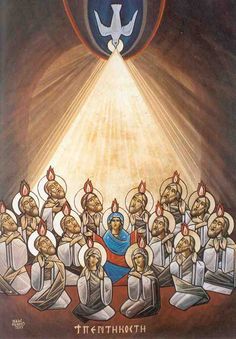
            Despite what we heard in the Acts of the Apostles this morning, the gift of the Spirit was more than the ability to proclaim the good news of God in Jesus of Nazareth in the many and diverse languages spoken among those who heard Peter speak two thousand years ago.  I realized that the primary gift of the Spirit was something more subtle but essential.

            The evangelist Luke tells us that Jesus spent forty days after his resurrection providing the apostolic community with a comprehensive ‘continuing education’ course on his mission and ministry.  The evangelist John tells of a number of encounters the apostles and others had with the risen Jesus.  So, it would seem that Peter and his community knew what the mission and ministry given to them was all about.  What they lacked was one thing:  courage.

            We know that the apostolic community was afraid.  We know that they were meeting behind closed doors.  We know that some had been arrested by the religious authorities.  We know that in a short time one will be stoned to death.  There were many reasons for the followers of Jesus to keep a low profile and off the radar screens of both the religious and imperial authorities.

            But all this changes on Pentecost.  Peter dares to come out of hiding and to proclaim the message of the resurrection to those who are gathered in Jerusalem.  From that day forth there is no more concealment.  Tradition tells us that from that day on, the followers of Jesus spread out throughout the Mediterranean world to share the mystery of faith:  Christ has died.  Christ is risen.  Christ will come again.


Courage is still needed.

            Courage, my friends, is not the absence of fear or concern.  It is not brashness or heedless of the risks.  Courage is the choice to act on our convictions – despite our fears and despite the risks.  I dare say that courage is still needed among the followers of Jesus, even in Canada.  That courage is needed in particular to confront the distortions of the message of the gospel that masquerade as Christian faith, but are really the worse angels of human nature cloaked in religious rhetoric and regalia.

            We know that goodness is stronger than evil, but it takes courage to be good when we are amid a sea of evils.  We know that love is stronger than hate, but it takes courage to love when we are afraid of the future and hate of the ‘other’ or ‘change’ or whatever other scapegoat lures us.  We know that light is stronger than darkness, but it takes courage to add our one small light when darkness seems so powerful and immense.  We know that life is stronger than death, but it takes courage to live boldly as the body of Christ when we are assaulted by the news of how death stalks our planet.

            It takes courage to be a follower of the way of Jesus in a neighbourhood where we seem to be invisible and irrelevant.  It takes courage to proclaim the truth of Jesus is a world where that truth has been distorted by those who claim to be its strongest advocates.  It takes courage to risk the life of Jesus when there are voices that whisper that love of neighbour rather than love of self ought to be the priority.

            But, my friends, two thousand years ago a small community of Jewish women and men were given the gift of courage.  They gave birth to a movement that is world-wide and world-changing, something that was infinitely more than they could ask or imagine.  For two thousand years women, men and children have embraced the responsibility to bear witness to the way, the truth and the life of Jesus, despite the temptations to pack it in and hide away.  All this was accomplished because of the one gift of the Spirit that matters more than any other:  the gift of courage, the gift to shy people such as we to get up and do what needs to be done.

            And that gift is ours – today and in all the days to come.


[i] Numbers 11.24-30; Psalm 104.24-34, 35c (NRSVue); Acts 2.1-21; John 7.37-39.


Saturday, May 16, 2026

It's Up to You Now: Reflections on the Ascension

Feast of the Ascension — St. John Orthodox Church

 RCL Ascension [i]

17 May 2026


Saint Helen’s Anglican Church

Vancouver BC


            In the summer of 1968, I was hired for my first real job.  Two of my grade 9 teachers had a fireworks business that they ran in the months before the 4th of July as a means of bolstering their teaching salaries.  They always hired students and these jobs were highly sought after – a side benefit was a generous supply of free fireworks.


            One of the teachers, Mr Kordula, taught woodworking and had designed a prefabricated road-side stand.  We set up a number of these stands along major roads – usually near a gas station so that we had access to a bathroom.  Since this was my first summer, I spent a week or so working with an older student who had worked for Mr Kordula and Mr Knox for two previous summers.  I learned a lot about how to keep accurate sales records and inventory as well as how to chat people up when they came to buy.


            On the first day of my second week, Mr Knox drove some other students and me to our assigned stands.  I got out and waited for someone else to join me.  Mr Knox asked me if I had plenty of water, my lunch and the cash box.  I said, ‘Yes’, and he said, ‘Great, I’ll see you around 5.00’ and drove off.  There I was, fifteen years old, with $100 in petty cash and change – the equivalent of $1000 today, in charge of my little stand on Nevada Avenue.  I admit that I was a bit worried and uncertain, but I really had no choice but to open up and get to work.


            I looked up to Mr Kordula and Mr Knox; all of us looked up to them.  It was great to work with them.  I felt safe when I was working with them.  What I hadn’t realized is that they were going to reward my trust in them with their trust in me.  On that day Mr Knox said without saying it, ‘It’s up to you now, Richard.’  Tuum est.


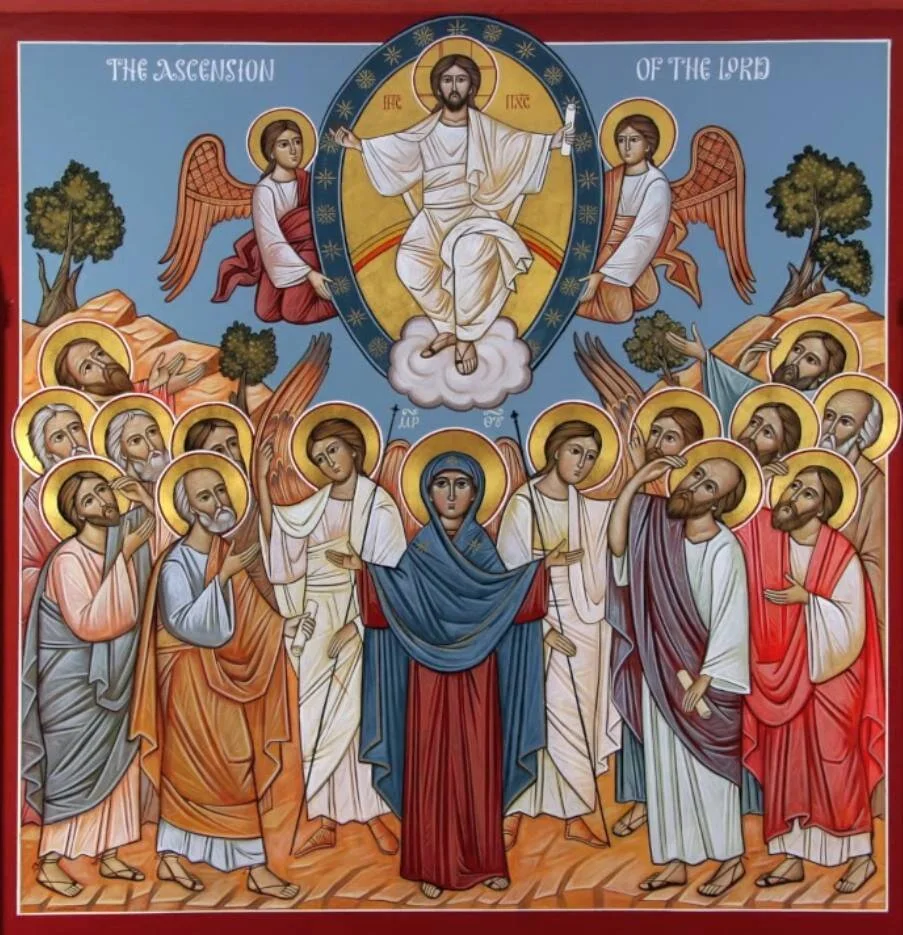
            Next week we will celebrate Pentecost, a festival that is often called the ‘birthday’ of the Church.  I actually think that Ascension, the festival we are keeping today, is the real ‘birthday’ of the Church.  It’s on this day that Jesus drops us off on a busy street we call ‘the world’, hands over to us the keys to the stand and drives off with a wave and a smile and breezy ‘Tuum est. – It’s up to you now.’


            Let’s put ourselves on that hilltop outside Jerusalem two thousand years ago.  According to Luke the evangelist, Jesus has spent forty days with the apostolic community.  Throughout those forty days, Jesus makes no public appearances; he just spends time with the women and men who are part of his community.  Someone might want to ask why Jesus didn’t go to the front door of the high priest’s home, knock on it and say, ‘Here I am.  What do you have to say now?’  But, as Luke tells the story, Jesus doesn’t.  I think that there is a simple reason:  the message of the good news of God in Jesus is one that is meant to be shared by human beings.


            In contrast to the celebrity culture that has pervaded human society from the very beginning, the culture of the gospel is wonderfully ordinary.  When we think about the early days of the Christian movement, we may want to focus on characters such as Paul, Peter, Barnabas and the like.  But the real foundation of the Christian movement was laid by the people who waved goodbye to Paul, Peter, Barnabas and the like as they left town.  These ordinary people were responsible for living a Christ-like life in Philippi and Thessalonica and Ephesus and all the other places around the Mediterranean Sea and even as far as the southwestern coast of India.  They were the ones who invited their neighbours to become part of this movement; they were the ones who sometimes paid the ultimate price for loving God and loving neighbour after the way of Christ.


            In every generation we have had saints and teachers, mentors and even celebrities, who could have become gravity wells that drew all the attention to themselves.  For the most part, they have not.  They have come into our midst, offered their wisdom and then, with a wave and a smile, went on their way with a cheerful ‘Tuum est.’  ‘It’s up to you now.’


            Here at Saint Helen’s, we have experienced both the joys and the sorrows of leadership that builds up the community and leadership that comes to an abrupt and troubling end.  If we were to buy into the celebrity and ‘influencer’ culture of our times, then we might well and truly be hooped.  But that is not who we are nor is it the culture of the good news.  The good news is that celebrities and influencers come and go, some for the better, some for the worse, but the beloved community for whom Christ lived and died always rises again, just as our Lord was raised.  We rise and accept the challenge made to every generation, ‘Tuum est.’  ‘It’s up to you now.’


            But to do this, we need the gift of the Spirit, the Advocate, the Comforter, the Counsellor, the Companion.  What I think the gift that the Spirit brings us – well, come next week and I’ll share those thoughts with you.


[i] Daniel 7.9-14; Psalm 24.7-10 (BAS); Acts 1.1-11; John 17.1-11 (alternative Hebrew Scripture reading and Psalm with Easter 7A Gospel).


Saturday, May 9, 2026

Infinitely More: Reflections on John 14.12-21

I go to prepare a place' and 'greater works' in John 14 | Psephizo 


RCL Easter 6A [i]

10 May 2026


Saint Helen’s Anglican Church

Vancouver BC


            When I was teaching at Vancouver School of Theology, my New Testament colleague, Lloyd Gaston of blessed memory, created an assignment he called, ‘From Text to Sermon’.  What he was trying to accomplish was to lead his students into a deep dive into a text.  Just as a diver might explore the depths of the sea and bring back to the surface beautiful objects or new species, so too the preacher needed to see what might be lurking among the words of a particular scriptural text.  I have sometimes called this, ‘searching for the Word among the words’.  Once that Word is found, a preacher can begin to craft a sermon.


            So today I’m giving you a ‘from text to sermon’.  We’ve spent a number of weeks during Easter journeying with one Gospel, perhaps the most difficult Gospel, so it’s time to take a little dive.


            If you were to tell me that I was going to be exiled to a distant island and that I could take only one of the four Gospels with me, then I would choose the Gospel according to John.  I have always found John to be the better storyteller, and his understanding that the kingdom of God is as much a present reality as a future hope energizes the work I have been called to do.  Another reason that I’d take John with me is this:  there are passages that I do not yet understand. Often in John’s Gospel, Jesus says things that are cryptic or clearly have multiple meanings all at the same time.


            Let’s take today’s reading from the Gospel.  As is permitted in our lectionary tradition, I added three verses from last week’s Gospel reading.  Adding these three verses helps to make clearer what I think John is saying to us today.


            From my first serious engagement with John’s Gospel, I have kept coming back to this verse:  “Very truly, I tell you, the one who believes in me will also do the works that I do and, in fact, will do greater works than these, because I am going to the Father.” [ii]  I am left with a question:  How can I, a flawed human being, do greater works than Jesus?


            Another matter in today’s Gospel arises from the fact that John was written in Koinē, a form of the Greek language spoken throughout the Mediterranean world during the New Testament era.  This means that you and I have to rely on the expertise of contemporary translators, but there are times when, despite their best efforts, translators cannot in a single word express what is being said.


            A case in point is the word translated as ‘Advocate’.  In Koinē the word is Paraklētos, and it is very difficult to find one equivalent word in English.  What the first audience of John’s Gospel would have heard is a constellation of meanings:


·      the one who exhorts

·      the one who comforts

·      the one who helps

·      the one who makes appeals on one’s behalf. [iii]


English translators have used a variety of words:  “Comforter” (the King James’ Version), “Advocate” (New Revised Standard Version), “Counselor” (New International Version), “Companion” (Common English Bible).


            When we put together Jesus’ words about doing greater things and the promise that God will give us one who exhorts, who comforts, who helps and who makes appeals on our behalf, the Spirit of truth, a key message from John’s gospel becomes clearer.  It’s a message that is enshrined in the motto of the University of British Columbia:  Tuum Est or ‘It is yours.’


            When Jesus returns to God, something that the Church will celebrate on Thursday, Ascension Day, responsibility for the mission and ministry begun in his life and teaching passes over to us.  While Jesus’ ministry was confined to a particular time and place, our ministry is no longer confined to any particular time or place.  What John the evangelist is trying to tell is this:  What Jesus does is who Jesus is.  What Jesus does reveals who God is.  What we do is who we are.  What we do in Jesus’ name reveals both who God is and what God is doing in our own times and places.


            If we were simply left to our own devices, then things might be even bleaker than they seem to be in the present moment.  But we are not left to our devices.  Even in our lowest moments, in our moments of greatest uncertainty, in our moments of doubt and near despair, we have a Companion who exhorts, comforts, helps and appeals to God on our behalf.  We have an Advocate who makes our case to a world in need of reconciliation and renewal, desperate for hope and courage.  Tuum est, says John, “It’s over to you, believers in Jesus, those who follow the way, who know the truth, who live the life.”


            It is over to us – with the Advocate’s help – to confront those who claim to be righteous while denying food to the hungry and shelter to the homeless.  It is over to us – with the Comforter’s help – to strengthen the weak, to heal the sick, to bind up the injured.  It is over to us – with the Counselor’s help – to back together those who have followed life-denying paths and those who have lost the way.  It is over to us – with the Companion’s help – to reunite those whom the powerful would divide.


            God, working in us, can do infinitely more than we can ask or imagine.  But more on this next week.


[i] RCL Propers using the alternative Hebrew reading and psalm:  Ezekiel 34.1-7a; Psalm 115; Acts 17.22-31; John 14.12-21 (expanded from 14.15-21).


[ii] John 14.12 (NRSVue).


[iii] Gail O’Day, “The Gospel of John” in The New Interpreter’s Bible (1995), IX.747.


Saturday, May 2, 2026

Jesus as the Way, the Truth and the Life: Reflections on John 14.1-14

A blessed Lord's Day to all! Todays Gospel reading is according to Matthew 9:27-35 At that time, as Jesus passed by, two blind men followed him, crying aloud, "Have mercy on us, 

RCL Easter 5A [i]

3 May 2026


Church of the Epiphany

Surrey BC


            Although I was born in England, I was raised in the United States.  My father’s family were among the first settlers from England and Wales to colonize the Hudson Valley of New York and the coast of Massachusetts.  From childhood I was taught to be proud of my family’s history and proud of its role in shaping what would become the United States.


            As I grew older, I began to learn things that made me more humble.  I knew that some of my ancestors fought in the American Civil War to end slavery, but I did know that sixty years before the Civil War, my family had counted enslaved people as property.  When I went to the Solomon Islands in 1997, I knew that clergy were treated with respect, but I did not realize that a whole family would be thrown off a small plane to make room for me and another colleague.  When in 2008 I flew into Singapore from Yangon with the Bishop of British Columbia, I knew that he and I were the only white people waiting to go through customs and immigration, but I was surprised when an immigration official took us out of the line so that we could pass through more quickly at the diplomatic gate.


            In our world today, there are people who are not afraid to use the privileges that come from being citizens of a particular country or from having wealth or from being white or from being male.  There are people who believe that being a Jew or a Muslim or a Christian or one religion or another gives them rights to exclude, to persecute or to dominate people of other faith traditions.


            Right now, both here in Canada, in the United States and in Europe, there is a movement called Christian nationalism.  It is a movement that teaches its followers that their countries and cultures are under threat by other people who profess other faiths.  Some of the followers of Christian nationalism believe that any efforts to ensure the fair treatment, full participation and opportunities for all people are wrong.  In the minds of Christian nationalists, there is a natural superiority that belongs to certain groups of people.


            Unfortunately, one verse of today’s reading from the Gospel according to John fuels the beliefs of Christian nationalists:  “Jesus said to (Thomas), ‘I am the way and the truth and the life.  No one comes to the Father except through me.’” [ii]  I admit that growing up in the Church, I probably thought that these words from the Gospel according to John were intended to claim that being a Christian is better than being a member of any other religion.  But this understanding is not what the writer of the Gospel means.


            The Gospel of John was written during a time when the first followers of Jesus, all of whom were Jews, were trying to explain how they understood Jesus.  Along with other Jews, the earlier followers of Jesus shared the same Scriptures, what you and I call the Old Testament or the Hebrew Scriptures.  These Scriptures tell how a particular people came to believe that they had a distinct relationship with the Creator of the universe.  Please note the word I used:  they had a distinct relationship with God not an exclusive one.  The Scriptures are full of stories of how people who were not Jews demonstrated that they were followers of God.


            What distinguished the Jews from other followers of God was the law and teachings that came to the Jewish people after their exodus from Egypt.  This law and its teachings came to them through Moses, but time and time again, God sent teachers and prophets to help the people find the right path, the good path.  So, when the earliest followers of Jesus explained how they were being faithful to God, they said that they were followers of the way of Jesus.  This way of Jesus, a way of self-giving love, of forgiveness, of generosity, of respect for the dignity of every human being, led the followers of Jesus to the truth of how to be in relationship with God and to find abundant life in the here and now.


            To follow Jesus as the way is to learn the truth of who God is and how to live Christ-like lives.  To follow Jesus is to know that our mission is not to be walls to set people apart but to build houses where all God’s children can live and flourish.  To follow Jesus is to proclaim the Christ who had a welcome for all people, who healed non-Jews as well as Jews, who ate with sinners and outcasts as well as rabbis and other religious leaders.


            I believe Jesus to be the way, the truth and the life.  But this belief is not a weapon to be used to belittle others nor a claim that Christians are superior to any other religious community.  Those who know the way, the truth and the life of Jesus do not carelessly speak about destroying civilizations or wage war as if it were a video game.  Those who have ears to hear know that the way of Jesus teaches us to do justice.  Those who have ears to hear know that the truth of Jesus teaches us to love our neighbours as God loves the world.  Those who have ears to hear know that the life of Jesus teaches us to walk humbly with God.


[i] Acts 7.55-60; Psalm 31.1-5, 15-16 (BAS); 1 Peter 2.2-10; John 14.1-14.


[ii] John 14.6 (NRSVue).