Saturday, May 20, 2023

Now What Do We Do? Reflections on the Ascension


RCL Easter 7A

21 May 2023


Holy Trinity Anglican Cathedral

New Westminster BC


            In the summer between Grade 9 and Grade 10, two of my teachers, Mr Knox and Mr Kordula, asked if I wanted to work in their 4th of July fireworks business.  These were the days when teachers were only paid nine months of the year and many supplemented their income by side businesses.  I was thrilled for two reasons:  In my school being asked by Mr Knox and Mr Kordula to work for them was considered a really special deal and, perhaps more importantly, I love fireworks.  One of the perks of working for the two Mr K’s was being able to take home $15 of free fireworks a week – US $15 in 1968 dollars!


             After two weeks of ramping up inventory, preparing assortment bags and putting the firework stands together, we were ready for business.  There were some older boys who had worked in previous summers, so each one took one of the younger boys – sorry, only boys in those days – under their wings.  My ‘mentor’ took me to our assigned stand and business began.  After a couple of days I learned that I would left on my own.  My ‘mentor’ would be driving a circuit to other stands to make sure all was going well.  I would be responsible for an eight-hour shift.


            The day of my solo debut arrived – a hot Colorado summer day, $50 in my cash box and several thousand dollars’ worth of fireworks on the side of a busy street.  My ‘mentor’ drove away – I had no car and was too young to drive – and I was on my own.  Within two hours I learned that the procedures manual did not cover all the situations I faced:


·      What do I do and where do I go if I need to use the washroom?  Answer – Thanks be to God for the friendly and sympathetic manager of the gas station next to my stand!

·      What do I do if I run out of change or end up with too many ten’s and twenty’s?  Answer – Make friends with the manager of the convenience store on the other side of my stand!

·      What do I do if some kid who has been saving up his allowance for weeks to buy an assortment pack comes up 10¢ short?  Answer – Be generous the first time and less generous on repeat occasions.


By the end of the summer I had learned a great deal and earned my employers a good return on their investment.


            I’m pretty sure that all of us have had a similar experience.  We begin a new job and undertake a new responsibility only to discover that there are many things not covered by our training or by the procedures manual.  Waiting around for our supervisors to return or for a revised procedures manual is not an option.  We have to use our natural talents and skills and trust whatever learned experience we have to do the best we can.


            Forty-three days ago, in a place far from here and two millennia distant, a small group of Jewish women and men had an experience that would eventually transform them into a potent movement of renewal and reconciliation that continues to this day.  Their beloved rabbi had been raised from the dead and had spent forty days with them.  During those days he had shared his heart with them.  He had told them that they were to be witnesses to his mission and to continue his ministry.  He had assured them that they would have the resources they needed to do what God wanted them to do.


            I am sure that the disciples expected that Jesus would remain with them forever.  But three days ago he was taken up into heaven and they were left gaping up into the sky.  I have always loved the two angels who come along and tell the disciples to move on.  The angels know what we know now – we are not called to stand around hoping that our supervisors will show up or a new procedures manual will be put into our hands. But I can’t help but think that the disciples asked themselves a question that generations of Christians have asked time and time again as we ‘are wearied by the changes and chances of this life’ – What do we do now?


            What do we do now?  First and foremost, we gather.  In his lengthy poem, ‘The Church Porch’ the Anglican poet and priest George Herbert writes:


Though private prayer be a brave designe,
Yet publick hath more promises, more love:
And love’s a weight to hearts, to eies a signe.
We all are but cold suitours; let us move

Where it is warmest. Leave thy six and seven;

Pray with the most: for where most pray, is heaven.


In a society where individualism and privacy have been asked to bear weight that they were never intended to bear, the Christian community acts in a counter-cultural fashion by holding up the coming together of people as a fundamental quality of being human.  It is gathering together as God’s people, whether within the walls of this cathedral or within the virtual confines of Zoom or Facebook, that we strengthen one another, encourage one another, enlighten one another, sustain one another.


            What do we do now?  When we gather, we transform ourselves and others.  The breaking open of the Word of God, the lifting up our intercessions, thanksgivings and petitions and our sharing in the bread broken and the wine poured have the power to take people who are weary, uncertain and discouraged and reinvigorate them, enlighten them and rekindle the hope that fuels the human heart and the Christian movement.  As we have been saying during this Easter season and will say again in a few moments, “Dear friends in Christ, God bids you welcome to this table.  Here we are strengthened for the journey.  Here strangers become friends and the seeker finds God’s wisdom speaking to them.  See who you are and become what you see.”


            What do we do now?  We gather.  We transform.  And we send.  As Jesus ascends, he does so in the confidence that his friends already have within the knowledge, authority and power to continue the work begun by God in creation, furthered by the covenant with the people of Israel and renewed in the ministry of Jesus of Nazareth.  No one can deny that our lives can be roller coasters of success and failure, hope and despair, clarity and doubt.  But what can be affirmed is that we are not alone and God’s commission is to a people, living in real places, in real times and in real circumstances.  At the end of the eucharist, the deacon takes on the role of the angels at the ascension and says, in so many words, ‘Don’t hang around here.  There is work to be done and we have the knowledge, skills, resources and power to do what needs to be done.  Move on!’


            Friends, there is work to be done.  We need to build up our resiliency as a community serving this downtown neighbourhood.  We need to build up our confidence in our future as witnesses to the risen life of Christ.  But most of all, we need to build up our hope and trust in one another, our joy in gathering, our joy in being transformed, our joy in being sent.  So let’s move on!


Saturday, April 15, 2023

Mission, Power and Choice: Reflections on John 20.19-31


Mission, Power and Choice

Reflections on John 20.19-31


RCL Easter 2A

16 April 2023


Holy Trinity Anglican Church

New Westminster BC


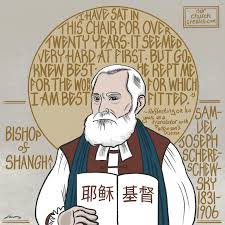
         In 1859 a recently-ordained deacon embarked from California on board a ship bound for Shanghai.  His name was Samuel Isaac Joseph Schereschewsky and he would spend the next forty-seven years of his life as a Christian missionary, bishop, educator and translator in China.


         Schereschewsky had already had an incredible journey, geographically and spiritually, before boarding that ship at the age of twenty-eight in 1859.  Born in Lithuania in 1831 to parents who were orthodox Jews, Schereschewsky was intended for the rabbinate.  But an encounter with a New Testament in Hebrew during his rabbinical studies convinced him that Jesus was the long-promised Messiah.  His spiritual journey then led him from his rabbinical college in Ukraine to Germany and then to the United States, from the messianic Jewish movement to the Baptists to the Presbyterians and finally to the Episcopalians.


         He eventually became Bishop of Shanghai in 1877 and was instrumental in establishing educational institutions and in translating the Scriptures and liturgical materials into various Chinese dialects.  But just four years into his episcopal ministry, Schereschewsky was stricken by a stroke.  He resigned as bishop in 1884 and spent the remainder of his life as a translator.  By the end of his life he was able to use only two fingers on one hand to type, but he persevered.  When asked by a reporter about his struggles and frustrations as a result of the stroke, Schereschewsky said, ‘It was hard at first.  But, in the end, God enabled to do the ministry I was suited to do.’


         Schereschewsky has always been a favourite modern saint of mine.  The bishop who ordained me, Bill Frey, always wanted to name a new parish after him but never did.  In Schereschewsky I have found a living example of some ideas I see in today’s familiar gospel reading from John.


         It is Easter evening and the Eleven along with other disciples are hiding, afraid of the religious authorities and the Romans, uncertain about the future and confused by the reports that their Lord is not dead.  Then Jesus comes into their midst, through the locked doors of the room and of their hearts.  In the space of a few moments he transforms them into a community with a purpose:  “As the Father has sent me, so I send you.” (John 20.21c NRSVue)  They are no longer a community of disciples, that is to say, students or protégés.  They are now an apostolic community, ambassadors, agents, the continuing presence of Christ in the world.


         It’s not enough, though, to be commissioned, to be called, they, and we, need to know what it is that God would have them, us, do:  “(Jesus breathed on them and said to them, ‘Receive the Holy Spirit.  If you forgive the sins of any, they are forgiven them; if you retain the sins of any, they are retained.’” (John 20.22a-23)


         They, and we, are given power to liberate or to oppress.  Throughout the Gospels it is undeniably clear that God in Jesus is at work liberating the creation from all that oppresses us, all that binds us.  God frees us form our fear of death; God frees us from our inability to become more fully human in the image of God and the likeness of Christ; God frees us from our selfishness and misuse of the resources God has entrusted to us.


         But in giving us the power to heal, God has also given us the power to hurt.  It is the divine dilemma:  by entrusting to us the power to do what we know God wants us to do, God must take the risk that we will choose to walk in other paths and to ignore the ‘better angels of our nature’.


         In Thomas the Eleven and the others face the first test of their commitment to the ministry of Jesus and the power that Christ through the Spirit has breathed upon them.  Do they embrace Thomas despite his doubts and sarcastic remarks or do they shun him?  They choose to embrace him and, in this sign, this work of God, we are able to “continue to believe that Jesus is the Messiah, the Son of God, and that through believing (we) may have life in his name.” (John 20.31bc)


         More than one hundred and twenty-five years ago Samuel Schereschewsky came to believe that Jesus was the promised Messiah and used the power given to him to build bridges between China and North America.  His legacy continues in St. John’s College at UBC, founded in 1997 by alumni of the original college in Shanghai, closed by the Communist government in 1951.  By the Spirit’s power Schereschewsky moved the two fingers left to him to continue the work of translating the Scriptures, a translation which is still used by Chinese Christians to this day.  He accepted the commission and used the Spirit’s power to build up and to heal, even when weakened and limited in his abilities.


         Through our baptism, you and I have been incorporated in this ministry of liberation God began in Jesus and continues in and through us.  We have been given power to heal or to hurt, to build up or to tear down.  The choice always lies before us, just as it did when the Eleven and the others pondered how to solve a problem like Thomas.


         Who are our Thomases?  From what do they, do we, need liberation?  On this Sunday, on every Sunday, on every day, Jesus has come through our locked doors and stands in our midst, waiting to see what we will choose.

Saturday, April 8, 2023

Walking Through Closed Doors: Reflections on John 20.1-18


RCL Easter A

9 April 2023


Holy Trinity Anglican Cathedral

New Westminster BC


            In the early spring of 1960 a small Lutheran congregation in Martha’s Vineyard offered a $100 prize in a local poetry competition.  The prise was won by a student from Harvard who wrote a poem entitled ‘Seven Stanzas for Easter’.  He donated the prize money, with a little over $1000 in today’s dollars, to the congregation.  His name was John Updike.


            John Updike went on to become one of the significant American writers of the later decades of the twentieth century.  In the view of some critics he ranks among the greatest American writers, while in the mind of other critics he was a voice of a conservative, uptight middle America.  To this day he remains a widely read author as well as a much debated one.  But his poem reveals a deep faith in the reality, the physicality of the resurrection, a faith he seems to have kept throughout his life.


Make no mistake:  if He rose at all

it was as His body;

if the cells’ dissolution did not reverse, the molecules

reknit, the amino acids rekindle,

the Church will fall.


It was not as the flowers,

each soft Spring recurrent;

it was not as His Spirit in the mouths and fuddled

eyes of the eleven apostles;

it was as His flesh:  ours.


The same hinged thumbs and toes,

the same valved heart

that-pierced-died, withered, paused, and then

regathered out of enduring Might

new strength to enclose.


Let us not mock God with metaphor,

analogy, sidestepping, transcendence;

Making of the event a parable, a sign painted in the

faded credulity of earlier times:

let us walk through the door.


The stone is rolled back, not papier-mâché,

not a stone in a story,

but the vast rock of materiality that in the slow

grinding of time will eclipse for each of us

the wide light of day.


And if we will have an angel at the tomb,

make it a real angel,

weighty with Max Planck’s quanta, vivid with hair,

opaque in the dawn light, robed in real linen

spun on a definite loom.


Let us not seek to make it less monstrous,

for our own convenience, our own sense of beauty,

lest, awakened in one unthinkable hour, we are

embarrassed by the miracle

and crushed by remonstrance. [1]


            Ever since that first Easter some two thousand years ago Christians and our critics have struggled to explain what happened to transform a small group of frightened and for most part working-class, uneducated Palestinian Jews into a movement that would eventually include two billion people in more than 45,000 distinctive expressions of the good news of God in Christ.  To some the resurrection is a spiritual experience, a mystical experience, an affirmation of our deepest hope that there is more to life than what we experience with our five senses.


            To others the resurrection is a metaphor, a story told to re-assure us that evil is always overcome by good, that life is stronger than death, love stronger than hate, justice stronger than oppression.  To some the resurrection is a story from a more naïve past when people lived in a world populated by gods, demi-gods and other mysterious beings.


            All these ways of understanding the resurrection offer us a means of comprehending what is, honestly compels me to say, is incomprehensible, whether two thousand years ago or today.  But these different ways, as well as all the other ways, do not describe what I believe to have happened on this morning outside Jerusalem.


            I believe that God raised Jesus of Nazareth from the dead in the fullness of his humanity, in the fullness of the person that Mary Magdalene, Peter, John and all the other witnesses to the resurrection knew and loved and mourned and touched.  There was, to be sure, something different about him, a quality of life that was, if you wish, other-worldly.  But it was Jesus, the Jesus who taught and healed and suffered and died.


            When we confess our faith in the resurrection, we are confessing our belief that matter matters, that God cares for the totality of what it means to be a human person – our bodies, our minds, our hearts, our souls, our memories, all that makes me me and you you.  To believe in the resurrection of Jesus is to believe that what we see and touch and celebrate in creation is the result of God’s loving intention.  The physical is not an accident but the result of God’s choice to make room for us in the kosmos.


            Gretchen Ziegenhals writes that “ . . . if we believe in the resurrection of the body, we will respect all bodies here among us – Black, brown and white bodies; rich and poor; male, female, trans and nonbinary; straight and gay; friend and stranger; young and old.” [2]


            While we wait for the resurrection – for our bodies and those of our loved ones to be ‘regathered’, as Updike describes – there is embodied work for us to do now, despite our pandemic limitations:  the work of justice and equity; the work of feeding and housing; the work of sharing bread, employment and fellowship; the work of making room for other voices and bodies; the work of ministering to the sick and the lonely in whatever ways we can. [3]


           When I was younger and regularly singing in my parish choir, I realized that there were hymns that I did not enjoy singing.  The tunes were lovely, but the words did not express what it meant to be a disciple of Jesus who was raised by God from the dead. Many of these hymns were the hymns of people who were oppressed and who struggled in their day-to-day lives.  They were filled with hope ‘in the sweet by and by, when we’ll meet at that beautiful shore’.  But I didn’t hear hope; I heard resignation and acceptance of the world as it is rather than working tirelessly and fearlessly for the world as God desires it to become.


           I have no certain knowledge of when creation will become what God desires it to become.  In the meantime I trust that God holds all the faithful departed in anticipation of that day when God’s purposes are achieved.  In the meantime I pray that “we, who share [Christ’s] body, [may live] his risen life; we, who drink his cup, bring life to others; we, whom the Spirit lights, give light to the world . . . so that we and all [God’s] children shall be free”. [4]  Why?  Because God raised Jesus from the dead, everything that made Jesus Jesus, and, in so doing, has shown us that matter matters to God and that we, everything that makes us us, matters to God, now and in the age to come.


[1] John Updike, ‘Seven Stanzas for Easter’ (1960).


[2] Gretchen E. Ziegenhals, ‘Walking through closed doors this Easter – the resurrection of the body’ https://faithandleadership.com/gretchen-e-ziegenhals-walking-through-closed-doors-easter-the-resurrection-the-body.


[3] Gretchen E. Ziegenhals, ‘Walking through closed doors this Easter – the resurrection of the body’ https://faithandleadership.com/gretchen-e-ziegenhals-walking-through-closed-doors-easter-the-resurrection-the-body.


[4] The Book of Alternative Services (1985), 214-215.


Friday, April 7, 2023

Good Friday -- Good Grief


On this Good Friday, I invite you to grieve and to lament.  We often, in my opinion, rush too quickly to Easter and, in so doing, fill the empty tomb with the baggage of our griefs and sorrows.

The Sermon begins at 24:45 in the recording.

Saturday, March 25, 2023

Can These Bones Live? Reflections on Ezekiel 37.1-14

Can These Bones Live?

Reflections on Ezekiel 37.1-14


RCL Lent 5A

26 March 2023


Holy Trinity Anglican Cathedral

New Westminster BC


A touch of the Holy

         A recent conversation with a colleague led me to re-read a sermon that I had given some seven years ago when I was Rector of Saint Faith’s in Vancouver.  Now, I do try to resist the temptation to re-visit previous sermons, but I found that some of what I said seven years ago is in harmony with what I want to share with you today.


         I cannot remember when and where it happened, but I do remember that happened.  I was participating in a celebration of the eucharist that involved a significant number of people.  As the deacon was preparing the table, I recall thinking to myself, ‘We’re going to run out of wine if that’s all that’s being placed on the altar.’


         Sure enough, about two-thirds of the way through the communion of the people, I noticed worried looks on the faces of the chalice administrators.  Each time they gave someone the wine, the administrators would look into the chalice and then at the master of ceremonies.  Without any hesitation the master of ceremonies, a lay person whose liturgical knowledge is great, walked over the altar, took the cruet with what remained of the consecrated wine and disappeared into the sacristy.  He reappeared with a full flagon of wine and began to refill the chalices of the administrators.


         After the service I had a private moment with the presider and the master of ceremonies.  I described what I had observed and expressed my ignorance as to how the master of ceremonies found such a large quantity of consecrated wine.  The master of ceremonies smiled and said to the presider with a side glance to me, ‘I did what you taught me to do.  I took what was left of the consecrated wine and poured it into a flagon of unconsecrated wine.’  


         What the master of ceremonies had done was an ancient practice where consecration takes place by contact or commingling.  It is an understanding that a touch of the holy can transform the ordinary.  We come to this time in the year exhausted, I think. The wonder and joy of Christmas has floated away.  Any plans we may have had for the new year are being seriously tested.  Lent came too quickly for most of us and we may not have been as faithful to our Lenten disciplines as we had hoped.  Insult has been added to injury by the change from standard to daylight time, an insult to my bodily rhythms that I am still feeling.  We know that there will be a number of changes in our life as a congregation over the coming months and that we are still some time away from the physical beginning of our re-development project.  We desperately need a touch of the holy to transform the ordinariness that has begun to claim our souls.


Can these bones live?

         The question that God asks Ezekiel is an apt one for us at this point in our life as a congregation:  “[The Lord] said to me, ‘Mortal, can these bones lives?’  I answered, ‘O Lord God, you know.’ – an inelegant way of Ezekiel saying, ‘I haven’t a clue!’  And then follows the vision of a people who have been dealt multiple blows – military defeat, death and destruction, foreign occupation, obliteration of the Temple, exile of the leading members of society to Babylon – being raised from these graves by God’s gracious and life-giving Spirit.  A touch of the holy brings life to the dry bones of Israel’s hopes and aspirations.


         At the end of today’s reading, the Lord leaves Ezekiel in no doubt as to the divine purposes:  “ . . . Thus says the Lord God:  I am going to open your graves and bring you up from your graves, O my people, and I will bring you back to the land of Israel.  And you shall know that I am the Lord when I open your graves and bring you up from your graves, O my people.  I will put my spirit within you, and you shall live, and I will place you on your own soil; then you shall know that I, the Lord, have spoken and will act, says the Lord.” (Ezekiel 37.12b-14)


         And God does restore the people to the land that they had received after their wilderness journey from Egypt to Canaan.  They grow and prosper.  The Temple is re-built.  But the winds of history blow strongly against them in the centuries to come.  The cycle of death and resurrection is repeated – the conquest of Alexander the Great and the victory of the Maccabees, the Roman occupation and the brief period of independence under Ben Kochba; the centuries of dispersion and persecution and genocide and the creation of the state of Israel.  Even Lazarus, raised by Jesus, must re-enter the tomb at some point in the future.  But for the moment he lives.  A touch of the holy makes dry bones and even foul-smelling cadavers live.


Raised from our graves

         I cannot help but think that the past decades and, in particular, the last few years have dug a few graves for many Christian communities in Canada and beyond.


         There is the grave of irrelevance.  As dismaying as it is, we cannot deny that many people, some of whom are our friends and families, seek religious communities such as ours as irrelevant to their daily lives.  Each time I speak to someone in the media or in public office who unintentionally reveals their complete lack of awareness of who we are and what we do in the community, I feel another shovel of dirt thrown on top of me.


         There is the grave of fatigue.  It is no secret that we share a similar challenge as many other groups devoted to community service – the challenge of finding new hands to carry on the ministries we know to be life-giving and life-sustaining, not only to ourselves but to our neighbourhoods.  When I have to determine what we can do and what we cannot do, I feel another shovel of dirt thrown on top of me.


         There is the grave of fear.  We have all given so much of ourselves to this enterprise we call ‘being disciples of Jesus’ that we can be fearful that we have given ourselves in vain.  Each time I meet someone who has given up on the faith or who has chosen a fundamentalist path of one sort or another, choices often motivated by some fear or another, I feel another shovel of dirt thrown on top of me.


         I am sure that there are other graves, but these will do for this time.


         I say these things to you out of a commitment to honesty.  Resurrection comes only after the pains of one form of death or another.  If we are truly to embrace the life that God promises us, then we must face unflinchingly the realities of the deaths God is bringing us out of.


         Out of the grave of irrelevance, God raises a people committed to the mission of creating life-giving and life-sustaining communities in the concrete realities of their neighbourhoods.  Out of the grave of fatigue, God raises new stewards of the resources of time, talent and treasure entrusted to us.  Out of the grave of fear, God raises us to a confident life in which we trust that God’s last word to us is never ‘death’ but ‘life’.


Out of the wilderness

         Time and time again, the witness of the scriptures is to the experience of having wandered in a wilderness of one form or another, longing to return home and being brought home.  We can be too eager to move quickly from the feeling of wandering and longing into coming home.  But to be able to embrace fully the life God offers us as disciples of Jesus, we must also embrace the time of wandering and questioning.


         As we face the coming months of this year and the changes that are coming, let us ask ourselves these questions:  What have we learned from our struggle to be relevant to the needs and concerns of our friends, families and neighbours?  What have we learned from our fatigue about inviting others to join us in ministry and embracing the new perspectives they bring to that work?  What have we learned from our fears that the values and character of this particular community, this Parish of Holy Trinity Cathedral, might not be fully shared by those who come after us?


         My friends, I know that our Redeemer lives.  I know that our God is breathing life into our dry bones.  I know that Christ is unwrapping, even now, any of the bonds that prevent us from experiencing the fullness of life, here and now.  Can these bones live?  Yes, Lord, they can – and they are.