Saturday, June 27, 2026

All Are Welcome in This Place: Reflections on Matthew 10.40-42


All Are Welcome in This Place

Reflections on Matthew 10.40-42


RCL Proper 13A [i]

28 June 2026


Saint Helen’s Anglican Church

Vancouver BC


“Whoever welcomes you welcomes me, and whoever welcomes me welcomes the one who sent me. Whoever welcomes a prophet in the name of a prophet will receive a prophet’s reward, and whoever welcomes a righteous person in the name of a righteous person will receive the reward of the righteous, and whoever gives even a cup of cold water to one of these little ones in the name of a disciple—truly I tell you, none of these will lose their reward.” [ii]


Won’t you be my neighbour?

         If you had visited my fraternity house on a weekday afternoon between 3.00 p.m. and 5.00 p.m., you would have found most of us upstairs in the television lounge watching a children’s program on the Public Broadcasting Service.  A slender, middle-aged man would enter the stage set, remove his outer coat and put on a cardigan.  As he was doing this, he would be singing, “It’s a wonderful day in the neighbourhood, a wonderful day in the neighbourhood, would you be my neighbour?”  His name was Fred Rogers, and he was an ordained Presbyterian minister who was among the first to grasp the impact that children’s television could have on raising responsible, compassionate adults.


         Now you might wonder why a group of often rowdy, irreverent college students would gather around the television watching a children’s program with the attentiveness of someone attending a papal mass in Saint Peter’s Basilica.  We did so because Mr Rogers had the gifts of speaking to us as young men who were legally adults but not yet who we might become.  In a society that still tries to mould young people after celebrity models rather than meaningful models, Mr Rogers liked us for who we were in that moment and offered us some wisdom about how we might become wise, welcoming adults.


         Every week Mr Rogers would leave his set and wander the neighbourhood, accompanied by a camera crew.  He would connect with interesting people – beekeepers, bakers, librarians, emergency services – the ‘usual suspects’.  But he would also spend time with people digging ditches or collecting garbage or fixing fences.  After each of those conversations, it was impossible not to realize that Mr Rogers was teaching us the dignity of every human being and that we depend upon each other for the creation of a just society.  He embodied a hymn, well known to Lutherans and only recently to Anglicans:


Let us build a house where love can dwell

and all can safely live,

a place where saints and children tell

how hearts learn to forgive.

Built of hopes and dreams and visions,

rock of faith and vault of grace;

here the love of Christ shall end divisions:

All are welcome, all are welcome,

all are welcome in this place. [iii]


Will you strive for justice and peace among all people, and respect the dignity of every human being?

         Although the gospel text for today focuses on welcome, I could not help but hear the word ‘neighbour’ throughout it.  A careful reading of the Scriptures – the Hebrew Scriptures, the Apocrypha and the New Testament -- will reveal a unifying theme throughout them that is at risk in our highly partisan and increasingly ‘other’-phobic culture:  the arc of welcome and inclusion is long but bends inevitably towards unconditional acceptance of every human being as our neighbour.


         We do not have time today for an extensive Bible study into this theme, but a familiar text from the New Testament but rooted in the Hebrew Scriptures will suffice.


When the Pharisees heard that [Jesus] had silenced the Sadducees, they gathered together, and one of them, an expert in the law, asked him a question to test him. “Teacher, which commandment in the law is the greatest?” He said to him, “ ‘You shall love the Lord your God with all your heart and with all your soul and with all your mind.’ This is the greatest and first commandment. And a second is like it: ‘You shall love your neighbor as yourself.’ On these two commandments hang all the Law and the Prophets.” [iv]


Our current tragedy is that many of our leaders seem to imitate the young lawyer in the Gospel according to Luke who asks Jesus, ‘But who is my neighbour?’  The young lawyer is rewarded with the Parable of the Good Samaritan, but its message does not seem to reach into the hearts of many with power. [v]


Love of neighbour is not easy.

         Loving one’s neighbour is not easy.  It is a prophetic ministry – bringing God’s word into the present moment with a call to action.  Prophets are rarely the most loved members of a community and are often rewarded with scorn, persecution, ridicule and death – both physical and social.


         It’s not easy because love of neighbour includes loving those whom we would rather ignore or exclude – each one of us has a list of those we would prefer not to have to encounter in our prophetic ministry.  I am reminded of a story about Bill Burnett, the Archbishop of Capetown from 1974 to 1981.  During the anti-apartheid struggle he would invite leaders of the government to breakfast or lunch.  They would arrive expecting a lecture, but instead they were treated to a gracious and compassionate conversation about their families, their hopes, their fears.  It was only then that Archbishop Burnett would talk about how apartheid was corroding the perpetrators as well as the victims.  Burnett was criticized by many, but I think he planted seeds that later bore fruit.


         It’s not easy because human beings have an uncanny ability to create ‘us’ and ‘them’ categories.  Rather than navigate the challenges of human diversity, we all have moments when we would prefer to paddle in a pond of sameness.  I remember speaking with one of my professors in seminary who had been an outspoken and courageous advocate for the ordination of women.  He had been in a funk and I asked him why.  He responded, ‘Because since 1976 the club has changed.’  He wasn’t wishing to return to the past; he was simply acknowledging that ‘stormy future’ was just that – stormy.


         In the weeks ahead Pride events will be taking placed throughout the Lower Mainland, our country and the world.  Many of us know from personal experience the conflicts that have raged over the recognition of the dignity and rights of the LGBTQIA+ community.  To this day there are too many places in the world where people are not free to be who they are and actively prevented from becoming truly free.  I cannot help but see this as a symptom of our human weakness and our failure to love our neighbours as fully as God loves every beloved in whom God’s image dwells.


         But the arc of welcome and inclusion continues to bend towards unconditional acceptance of every human being as our neighbour.  And the question asked by Mr Rogers continues to be the question God asks of us each day, in every encounter, in every relationship, ‘Won’t you be my neighbour?’  Dare we say ‘No’?


[i] Genesis 22.1-14; Psalm 13; Romans 6.12-23; Matthew 10.40-42.


[ii] Matthew 10.40-42 (NRSVue).


[iii] Marty Haugen, “Let Us Build a House,” Sing a New Creation (2022) #10.


[iv] Matthew 22.34-40 (NRSVue).


[v] Luke 10.25-37 (NRSVue).


Saturday, June 6, 2026

Where God's Call Meets Our Deepest Need: Reflections for the 2nd Sunday after Pentecost

A Children's Sermon on Matthew 9:9-13, 18-26 - Proper 5(10) - Gary Neal  Hansen - 

RCL Proper 10A [i]

7 June 2026


Saint Helen’s Anglican Church

Vancouver BC


Introduction

         Over the past several weeks Jeffrey and I have been following a common path in our preaching – that God entrusts to us, to all of humanity, a role in God’s mission to re-create, to redeem and to renew our world.  At times this mystery seems foolish to those who do not share our faith and overwhelming to those who do.  But we cannot escape this truth:  what we do, as disciples of Christ, matters to God and can achieve ‘more than we can ask or imagine’.  


         Today’s readings lead us even deeper into this mystery.  They beckon us to consider our vocation, our call.  Frederick Buechner, the American writer and theologian, once wrote that “Vocation is the place where our deep gladness meets the world’s deep need.”  I am bold enough to take this quotation and to re-work it slightly:  Often God’s call to us responds to our deepest need as individuals and as communities. [ii]  


Leaving Haran behind

         Why would Abram pack up all his belongings and leave everyone and everything he knew behind to begin a life-time journey in stages?  Because God’s call spoke to Abram’s deepest need – a longing for a legacy.  Paul picks up on this need in today’s reading from the Letter to the Romans:  “Hoping against hope, he believed that he would become ‘the father of many nations,’ according to what was said, ‘So shall your descendants be.’” [iii]


         Some years ago as Archdeacon of Westminster, I had to participate in the difficult task of bringing the ministry of the Parish of Saint Catherine’s in Port Coquitlam to an end.  As you can imagine, there were strong emotions and, to be honest, strong disagreements.  But the Parish had the good fortune to be working with their Regional Dean, Eric Mason, the then Rector of Saint Laurence’s in Coquitlam.  Eric asked a simple question, ‘What legacy do you wish to leave?’  Because Saint Catherine’s had a long-standing and strong commitment to pastoral care, they rallied behind this question and left a large endowment to support hospital and care-home chaplaincy in the Diocese and especially in the Fraser Health Authority.  And their legacy endures.


Leaving profit behind

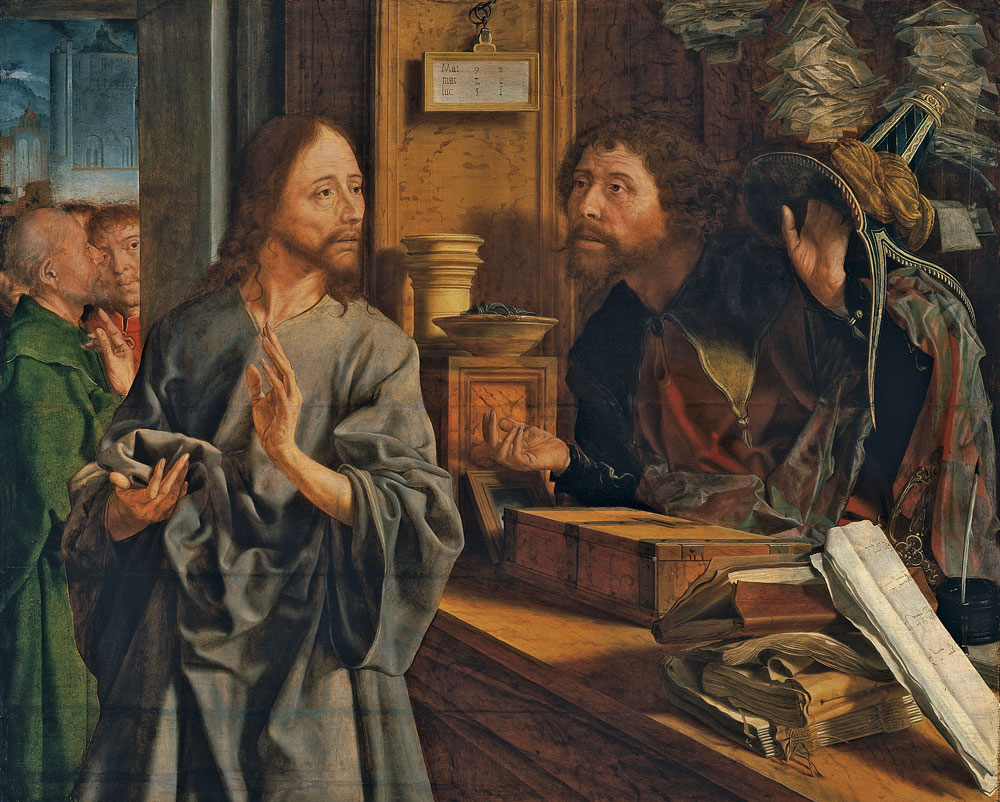
         Why did Matthew heed Jesus’ call to leave a profitable if unpopular occupation behind him and to venture a life of wandering from town to town?  Because Jesus spoke to Matthew’s deepest need – acceptance.


         Perhaps you remember the comedy series, Cheers, that centres around the patrons of a bar in Boston.  Some of the patrons are of dubious character, others endearing, still others eliciting deep sympathy.  But the theme song of the series expressed what all of them were seeking: 


Making your way in the world today
Takes everything you've got
Taking a break from all your worries
Sure would help a lot
Wouldn't you like to get away?


Sometimes you wanna go

Where everybody knows your name
And they're always glad you came
You wanna be where you can see (Ah)
Our troubles are all the same (Ah)

You wanna be where everybody knows your name. [iv]


         Jesus accepts Matthew just as he is.  Jesus dines out with those folk whom the ‘right’ people avoid like the plague.  But Jesus knows their names.  It is his acceptance of who they are that is the catalyst for them becoming who they are called to be.  All of us need to have a place where we are known and accepted and given a vision of what can be.


Leaving propriety behind

         Why did the leader come to Jesus and to risk his reputation to seek the aid of an itinerant Jewish rabbi often at odds with the establishment?  As we know from earlier verses in today’s gospel, reaching out to Jesus is not exactly career-boosting or socially acceptable.  But Jesus spoke to the leader’s deepest need – hope and healing.


         Why did the woman suffering such a life-changing ailment reach out to Jesus and risk rejection for crossing all boundaries of proper behaviour between Jewish women and men?  Just as the leader was taking a risk, so was this woman.  Nothing generates hostility faster than breaking a cultural taboo.  But in Jesus she saw the answer to her deepest need – hope and healing.


Our deepest need

         As I look at the Church in this third decade of the twenty-first century, I see a community that longs for hope, for healing, for legacy.


         Hope is grounded in a vision of what can be even given all the obstacles we believe we are facing.


         Healing cannot be achieved without hope.  Even as we acknowledge our woundedness, hope empowers us to discern the path towards wholeness (sōtēria).


         Hope-filled and healing communities have the potential to to entrust to succeeding generations a legacy of help, hope and home.


         When the new food pantry was installed in the parking lot, the organizers asked if I would share a few thoughts about why, in an affluent neighbourhood such as West Point Grey, a food pantry was appropriate.  ‘Because,’ I said, ‘behind many of these doors are hungry people – seniors, students, families stretched beyond their means – they need a sign that we see them and we are a place of help, of hope and of home.’


Faith is not passive.

         There is a tradition in Judaism known as midrash, a method of interpreting biblical texts that bridge the gap between the literal text of the scriptural texts and the questions of later generations.  One midrash tells the story of Nachshon, a young leader of the tribe of Judah.  When the people of Israel arrived at the Red Sea as they sought to escape the army of Pharaoh, Nachshon walked into the sea until the waters reached his nose.  Only then did the waters part and allow the Israelites to cross safely to the other side.


         This story reminds us of a simple truth:  Faith in God’s promises is not passive.  We are always called upon to act in anticipation that God will fulfill the promise made to us – perhaps to our ancestors in the faith, perhaps to those who will come after us.


         Abram did not wait for the fulfillment of the promise.  He packed up and made his way towards Canaan and a future he would not see fully realized.


         Matthew packed up, left his business behind and followed Jesus from Galilee to Jerusalem and beyond.


         The leader and the woman took the risk of social disapproval in the hope of healing and restoration.


         Hope, help and home are among the deepest needs of every human being.  They are the legacy we have received.  They are the gifts we offer.  They are the legacy we strive to leave.


[i] Genesis 12.1-9; Psalm 33.1-12; Romans 4.13-25; Matthew 9.9-13, 18-26 (semi-continuous Hebrew Scripture readings).


[ii] Frederick Buechner, Wishful Thinking (1973) at https://www.frederickbuechner.com/quote-of-the-day/2022/11/14/vocation.


[iii] Romans 4.18 (New Revised Standard Version updated edition).