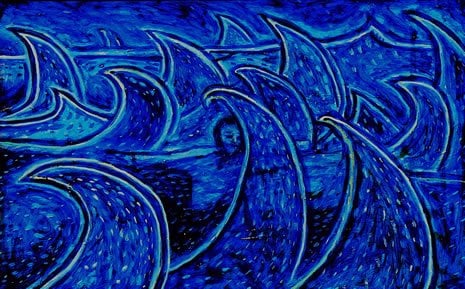
Art by David Brook
https://www.chabad.org/blogs/blog_cdo/aid/2172694/jewish/Nachshon-Ben-Aminadav.htm
RCL Proper 24A [i]
13 September 2026
Holy Trinity Anglican Church
Vancouver BC
Teasing out the meaning
In January 2012 I was part of a group of Jewish and Christian clergy who travelled to Israel and the West Bank. Our journey was something more than a shared journey to sites that had meaning for both our traditions. We were also learning how our traditions read and interpreted our Scriptures.
One of our stops was to a yeshiva, a Jewish theological school, located northwest of Jerusalem. As we approached the main classroom, I noticed that there was a kind of buzzing sound. When the doors opened, the source of the sound became clear. It was the sound of more than a hundred students who were studying the Torah, the first five books of the Bible.
The students were seated in pairs at small tables, each table stacked with a number of books. At the centre of the table was an open Bible and each pair was engaged in a vigorous discussion of an assigned text. Once and a while, one or the other would open one of the other books, commentaries on the Scriptures, to illustrate a point or to dig more deeply into the text. The professors would roam the room, pausing at a table to listen to the discussion and occasionally to intervene with a word of wisdom or direction.
I learned that in the Jewish tradition it is essential that each text is seen as a mother lode of meaning. No matter how obvious a text may seem, no matter how obscure or irrelevant a text may seem, it is the job of the faithful reader to dig into that mother lode to explore the possible meanings. And, just as it is essential to dig, it is essential in the Jewish tradition to have a partner or two with whom to work. That partner might push us to consider an alternative or challenge our interpretation.
When did the waters part?
One of the ways that Jewish teachers have dug into the meaning of the scriptures is by telling stories that expand upon the text. These stories are called midrash, a word that comes from the Hebrew meaning ‘to search out’ or ‘to inquire’. Midrash is a way of interpreting a text to explore its deeper ethical, legal or spiritual meanings beyond the literal text itself. Midrash is not meant to replace the text, but to be used as a means of waking our spiritual imaginations to consider the possible meanings a text may have for how we live our lives.
One of my favourite midrash is connected with the story of the parting of the Red Sea, our first reading this morning, and asks, ‘When did the waters of the sea part?’ The hero of the story is Nachshon, an ancestor of David. Imagine for a moment the people of Israel on the shores of the sea. They can see the dust cloud of the pursuing Egyptians and they can hear Moses tell them that God will part the waters – but nothing is happening. Moses is encouraging them and the Egyptians are drawing closer each minute, but the waters remain an obstacle.
From out of the crowd steps Nachson, a leader of the tribe of Judah. He steps into the waters, but they do not part. He walks further out into the waters, but they still do not part. He continues to walk until the waters rise above his nose, and then – the waters part and Nachshon leads the people across the dry seabed and to safety.
This midrash reminds us that trusting in God does not release us from the responsibility to act. If we pray for God to relieve the needs of the poor and hungry, then we act, trusting that God will supply our needs as we reach out. If we pray for justice and reconciliation, then we act, trusting that God will guide us as we go out as blessed peacemakers and ambassadors of reconciliation. We may find ourselves ‘up to our noses’ in challenges, but it is such moments that God’s grace breaks into our lives.
How many times?
In today’s parable Jesus gives us an example of midrash. Peter asks a simple question, how many times should I forgive someone. We know from other sources that Jewish tradition at the time suggested three times. [ii] Peter goes even further in suggesting seven times. Jesus does Peter ten times more – seventy-seven times! To illustrate his interpretation of the tradition, Jesus tells Peter and the others the parable we heard.
We are reminded of that petition in the Lord’s Prayer that I consider one of the most difficult prayers we ever offer: “Forgive us our trespasses as we forgive those who trespass against us.” Have you ever noticed that we are asking God to measure out forgiveness of our sins in the same balance as we forgive the sins of others? I know my own shortcomings as a person of forgiveness, so each time I pray the Lord’s Prayer I am reminded of all those times that I have failed to forgive.
The forgiven but unforgiving servant was unwilling to walk into those waters. Having managed to save his own neck, he shows that he has learned nothing, that he is unwilling to live into a new future where forgiveness rather than pay back is the guiding light.
Today’s parable builds upon last week’s reading about seeking reconciliation in the midst of conflict. I want to be clear about something. Forgiveness is not forgetting. Forgiveness is not about pretending that nothing ever happened and that nothing has changed in our relationships. Forgiveness is taking the risk to walk into the waters of conflict in order to seek a new path towards God’s future for us and for those with whom we are in conflict. We decide to trust God to lead us into a shared but different future than we might have had.
Up to our noses
These days I sometimes feel that being a person of faith is like being up to my nose in troubled waters. Perhaps you feel that way sometimes as well. But the story of Nachshon reminds us that God is at work even when the waters seem close to overwhelming us. The parable of the unforgiving servant reminds us that forgiveness can be the beginning of a path towards God’s future even if that path is not entirely clear.
Some time ago I became acquainted with a prayer from the Lutheran tradition. I return to it time and time again in times such as ours. I close with it today.
O God, you have called your servants to ventures of which we cannot see the endings, by paths as yet untrodden, through perils unknown. Give us faith to go out with good courage, not knowing where we go, but only that your hand is leading us and your love supporting us; through Jesus Christ our Lord. Amen.[iii]


No comments:
Post a Comment